Why it’s made this way.
Each part of Sunday Visit draws on published research about what helps older people, and about how they use phones. Here’s what the studies found, how strong the evidence is, and what it doesn’t show.
Before you read
None of these studies tested Sunday Visit. They tested activities like slow breathing, music and talking about the past, often with trained staff, in groups, over several weeks. They explain why each part is in the app. They don’t promise what it will do for any one person.
Sunday Visit is a wellbeing and accessibility app. It isn’t a medical device, a treatment or an emergency service. If you’re worried about someone’s health, talk to their doctor.
Sources last checked on 27 October 2026.
Last reviewed: 1 November 2026
For practical, step-by-step help, see our guides for families.
Two good places to start: how to make a phone simpler for seniors, and apps for elderly parents in aged care.
Calm
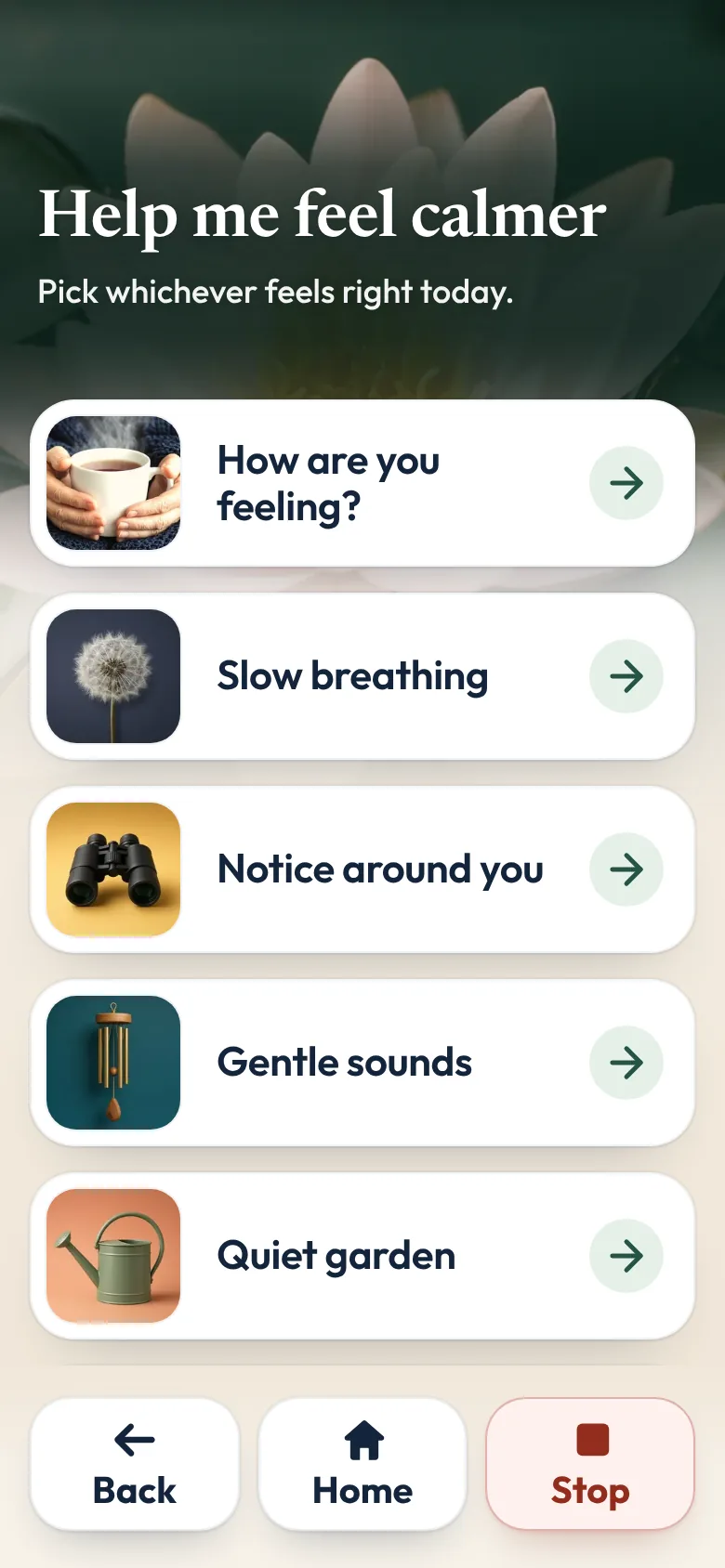
Quiet things to do. How are you feeling? offers six simple answers and suggests one thing to do; the answer stays on the phone. Slow breathing guides eight slow breaths at a gentle or a slower pace, then stops by itself. Notice around you goes from five things they can see down to one thing they’re glad of. Gentle sounds plays rain, a river, a fire, ocean waves, frogs and crickets, or birdsong, and fades away after 30 minutes. In the quiet garden, a flower grows wherever they tap the grass. Call, with a trusted person’s name, opens the phone’s own dialler for them, and Hear from family plays the sounds the family turned on, one after another.
-
Slow breathing, and the body
Slow breathing has been studied a lot. Across 223 studies, it raised heart rate variability, a measure linked to the body’s rest-and-recover system, while people breathed slowly and afterwards.
A review and meta-analysis of 223 studies (2022). Source 1
-
Slow breathing, and stress
In 12 randomised trials with 785 adults, people who practised breathing exercises reported less stress than people in comparison groups. The difference was small to moderate. Ten of the 12 trials mainly used slow breathing.
A meta-analysis of randomised trials (2023). Source 2
-
A longer out-breath
In an experiment with 23 students, breathing with a long out-breath felt more relaxing than breathing with a long in-breath. Both of the app’s paces breathe out for longer than they breathe in. The gentle pace, in for 4 seconds and out for 6, is the pattern the study with older adults below used; no study we found has tested the slower one, in for 5 and out for 7.
One laboratory experiment (2014). Source 3
-
Slow breathing in older adults
A study with no comparison group tried 5 minutes of slow breathing with a long out-breath in 22 older and 25 younger adults. Both felt less anxious, and one measure of heart rate variability rose.
One experiment with 47 adults (2021). Source 4
-
Noticing what’s around you
We couldn’t find a published trial of this five-senses exercise itself. Its nearest relative is mindfulness, which trains calm attention to the present moment. A review of 136 trials found mindfulness courses eased anxiety, low mood and distress compared with doing nothing, but other wellbeing activities may help as much.
A review of 136 randomised trials (2021). Source 5
-
One thing they’re glad of
The last step is a very small gratitude exercise. A review found gratitude exercises bring small gains in wellbeing, though no more than other helpful activities. In 88 people aged 60 and over, writing down three good things for two weeks was followed by a rise in one wellbeing score, and a dip in stress that didn’t last.
A meta-analysis (2016) and one study of 88 older adults (2015). Sources 6 and 7
-
Natural sounds
Pooling 18 studies, people who heard natural sounds had less stress and annoyance, and better mood and health, than comparison groups. Water sounds had the strongest link with health and good mood.
A review of 36 studies, 18 of them pooled (2021). Source 8
-
The sound of a fire
In three experiments with 226 adults, watching a video of a fire with its crackling sound was followed by lower blood pressure, more so the longer people watched.
Three experiments (2014). Source 9
-
A garden to look at
We found no studies of a garden drawn on a phone. The research is about real nature. In a well-known study, surgery patients whose window looked onto trees went home a little sooner than matched patients who faced a brick wall. And a review of six experiments found real nature lifted good feelings and virtual copies didn’t, though both eased bad ones.
One study of 46 patients (1984) and a review of 6 experiments (2020). Sources 10 and 11
Keep in mind
Most of these studies were small and short, and most involved younger adults: one review of slow breathing left out people over 65 altogether (Source 12). Many tested longer sessions, or practice over weeks, not one round of eight breaths.
We found no studies of a drawn garden or this exact five-senses walk. They’re in the app because they’re pleasant and easy, not because research tested them.
If slow breathing ever feels uncomfortable, stop and breathe normally.
Album
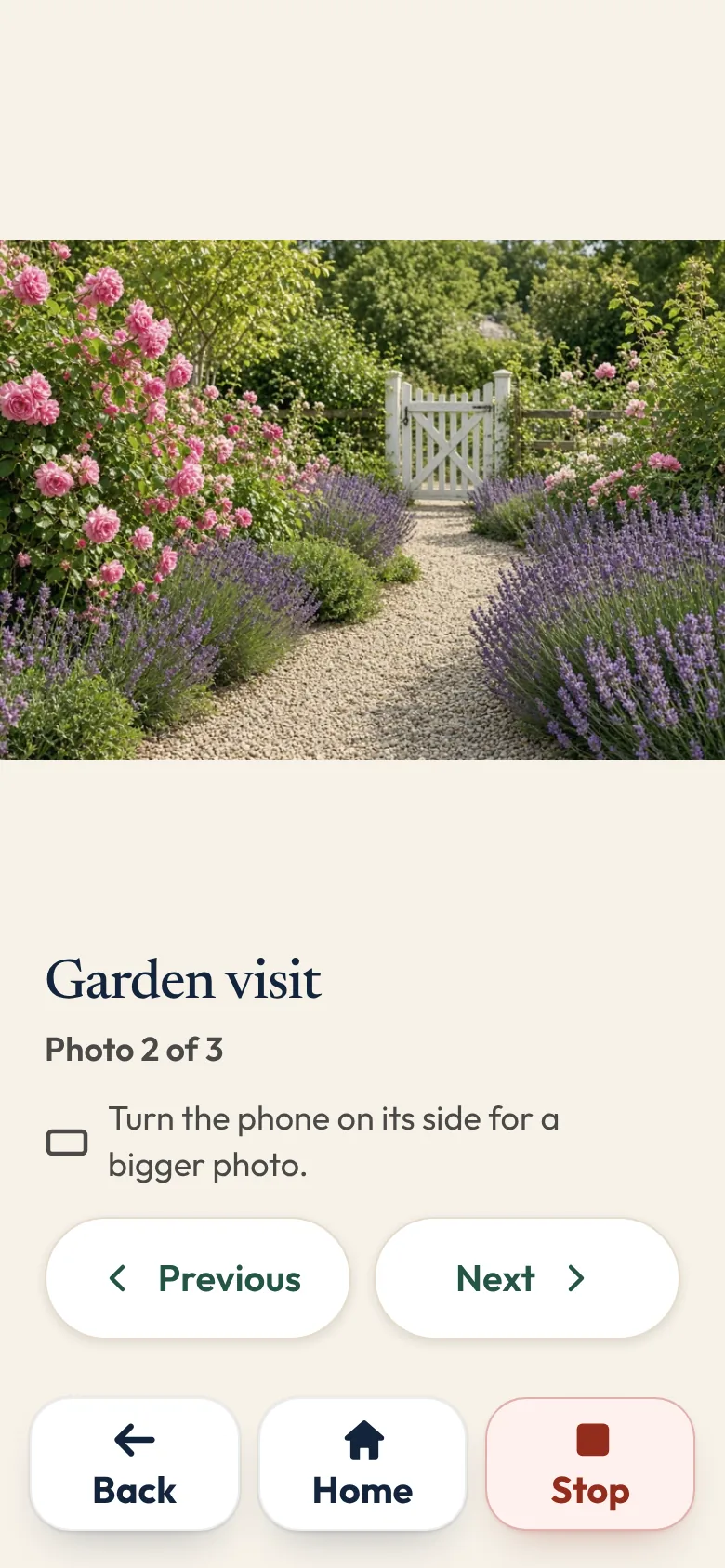
Up to 200 of the family’s photos, sounds and short videos, in three lists, newest first. A photo opens whole, with “Photo N of M” and big Previous and Next buttons. Each one has a name, like “Our wedding, 1968”, and can have a short description. Family add them from the Carer app, and the phone itself can take photos and record sounds and videos.
-
Photos and life stories
Looking through personal photos and keepsakes with someone is at the heart of “life story” work. In a review of 14 small studies of life story books for people with dementia, some found better recall of personal memories, less low mood, and better relationships with family carers. The reviewers called it promising, and want bigger trials.
A systematic review of 14 studies (2018). Source 13
-
Photos and films on a screen
A review of digital reminiscence in care homes, covering 16 studies with 365 people, found that photos, films and apps generally went with better mood and more social contact, though results were mixed.
A scoping review of 16 studies (2026). Source 14
-
Long-known songs
Memory for long-known music is often surprisingly well kept, even in Alzheimer’s disease. Brain imaging suggests why: the areas that hold long-known songs are relatively spared. The study didn’t test the music memory of people with the disease.
A brain-imaging study (2015). Source 15
-
Music and mood
For people with dementia, a review of 30 trials with 1,720 people found that music sessions probably ease low mood slightly, and may improve behaviour overall, by the end of a course. They probably don’t reduce agitation, and no lasting effects were found.
A Cochrane review of 30 trials (2025). Source 16
-
Their own music
In a trial in 54 nursing homes, playlists of each person’s favourite music didn’t reduce agitation in care records. But when trained observers watched 976 residents with dementia, they saw more pleasure and less verbal agitation.
A randomised trial in 54 nursing homes (2024). Source 17
-
How much music
In trials with older adults, listening to their own favourite music for more than an hour a week lowered depression scores compared with usual care. Smaller amounts made no difference.
A network meta-analysis of 15 trials (2022). Source 18
-
Recorded family voices
A 2020 review found only three small trials of playing audio or video recordings of family members to people with dementia. The reviewers couldn’t draw any conclusions.
A Cochrane review of 3 trials (2020). Source 19
Keep in mind
Most of these studies involved people with dementia, often in care homes, and usually with trained staff or music therapists over several sessions. None tested a family’s photos and songs on a phone at home.
So Album is there because familiar faces and songs matter to people, not as a treatment for anything.
For practical steps, see Share family photos on a phone, in one shared album.
Move
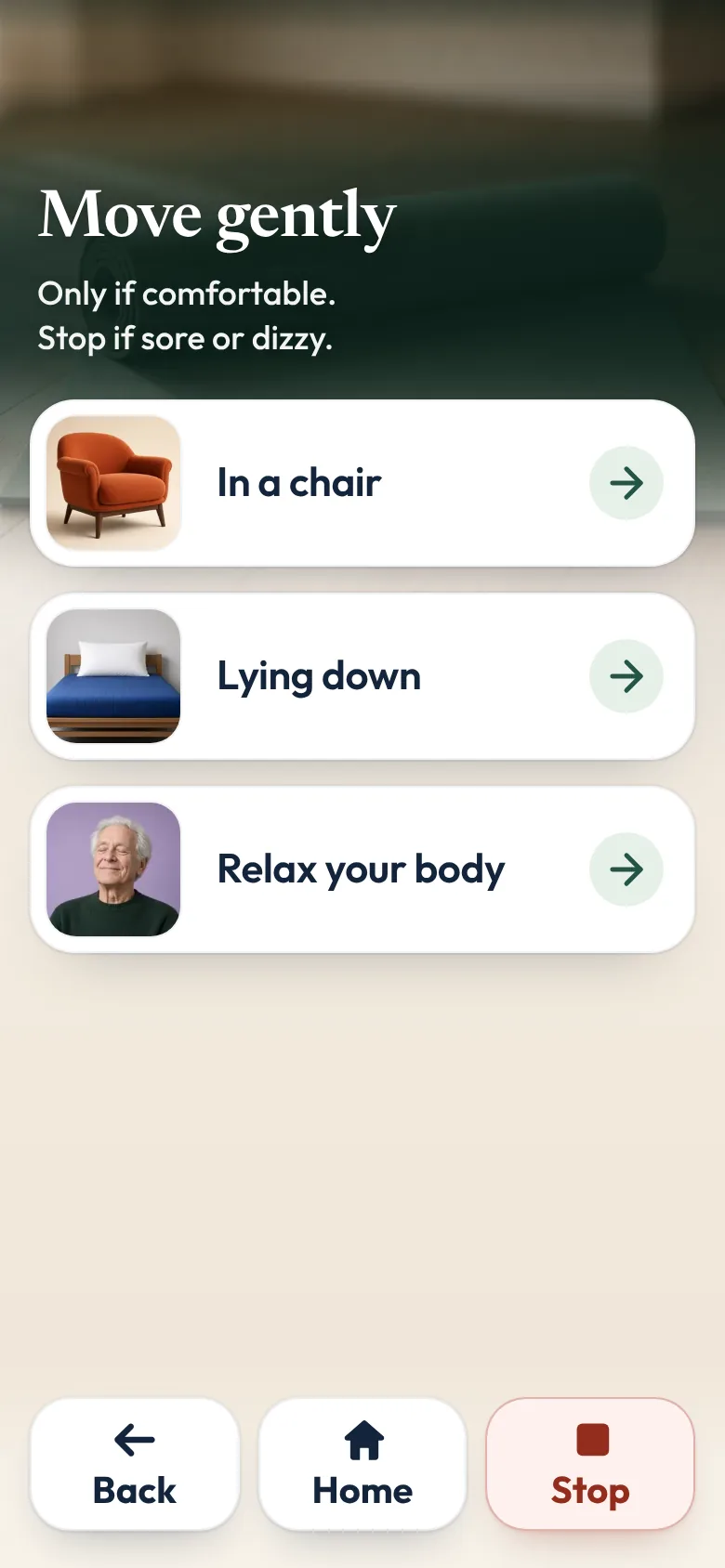
Short, gentle sessions with no counts or targets. In a chair: shoulder rolls, head turns, heel lifts, opening and closing the hands, and a slow reach. Lying down: ankle circles, knee bends, arm raises and a few slow breaths. And Relax your body, a body scan that moves slowly from feet to face. Above all three, the screen says: “Only if comfortable. Stop if sore or dizzy.”
-
Some movement is better than none
The World Health Organization’s guidelines say that for older adults, some physical activity is better than none. They suggest starting small, building up gradually, and being as active as their abilities allow. They also advise less time sitting, and say swapping sitting time for movement of any intensity, even light, has health benefits.
WHO guidelines (2020). Source 20
-
Moving in a chair
A review of 25 studies with 1,388 older adults found that seated exercise programs improved arm and leg strength, with no clear effect on balance or walking speed.
A systematic review and meta-analysis (2021). Source 21
-
For people in care
A review of 67 trials with 6,300 people living in care homes found that physical rehabilitation may reduce disability a little, with few side effects.
A Cochrane review of 67 trials (2013). Source 22
-
A body scan
On its own, a body scan has shown only a small effect: a review of 14 studies found it lifted mindfulness a little, but wasn’t enough by itself to improve health. It’s usually one part of longer mindfulness courses, which have had modest benefits for older adults, including for low mood, worry and stress.
A review of 14 studies (2022) and a meta-analysis of 46 studies in older adults (2025). Sources 23 and 24
Keep in mind
Sunday Visit’s Move isn’t a falls-prevention program. The exercise shown to reduce falls is challenging balance exercise, often with strength work, that gets harder over time and is done three or more times a week (Sources 25 and 26). If falls are a worry, ask a doctor or physiotherapist about one.
On their own, these short sessions don’t meet the World Health Organization’s recommended amounts of activity for older adults, and the studies above tested longer, structured programs, not this app.
Games
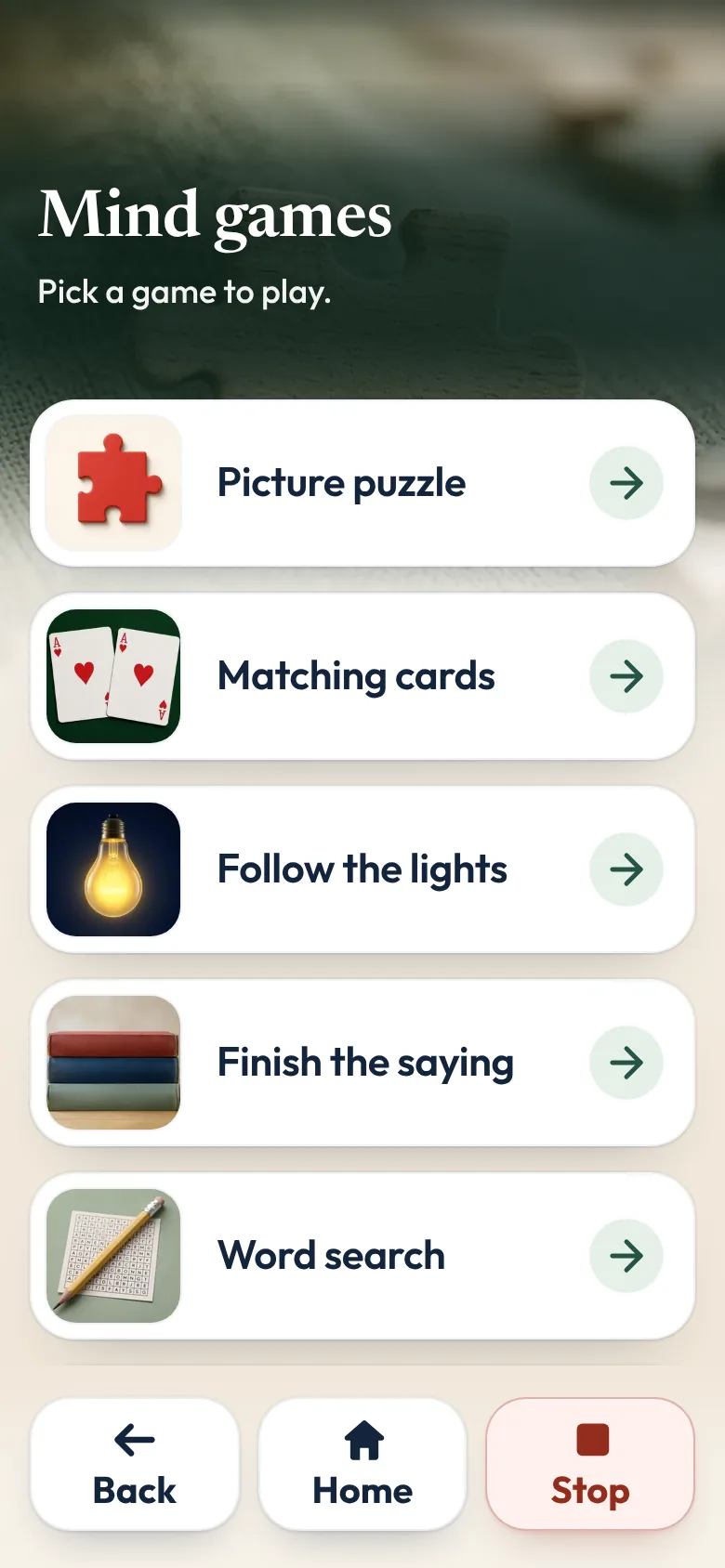
Quiet games: a picture puzzle with four, nine or sixteen pieces, matching cards that start face up (which two people can also play, taking turns), Follow the lights, Finish the saying, Word search, a new puzzle of calm, familiar words each time, and Little crossword, three everyday words filled in with big letter buttons. No scores, no time limits and no losing. After two misses, Follow the lights gets one light shorter, and Finish the saying offers a rest every six sayings.
-
Activities they enjoy
The NICE dementia guideline for England recommends offering people living with dementia a range of activities to promote wellbeing, chosen to suit what each person likes.
NICE guideline NG97 (2018). Source 27
-
Thinking games, together
The same guideline recommends group cognitive stimulation for people with mild to moderate dementia: enjoyable, sociable activities for thinking, concentration and memory. In 37 trials with 2,766 people, it probably gave small, short-term gains in thinking and in quality of life.
NICE guideline NG97 (2018) and a Cochrane review of 37 trials (2023). Sources 27 and 28
-
Brain training
For older people without memory problems, a review of computer brain training found low-quality evidence of a small gain straight after training, and no sign that it lasted a year.
A Cochrane review of 8 trials (2020). Source 29
-
Familiar sayings
People with Alzheimer’s disease often keep using familiar set phrases, like sayings and everyday expressions. In one small study, these made up a bigger share of their speech than for people without dementia. Explaining a proverb’s meaning is often harder, and doctors use it as a test. Finish the saying only ever asks for the familiar ending.
A small language study (2013) and a review of 25 studies (2011). Sources 30 and 31
Keep in mind
These games are short, played alone, and haven’t been studied. They aren’t cognitive stimulation or brain training, and NICE advises against offering cognitive training to treat mild to moderate Alzheimer’s disease (Source 27).
They’re there to be enjoyed. They don’t treat or prevent memory problems.
For calm games and activities on a phone, see Calm games and activities for seniors, with no ads.
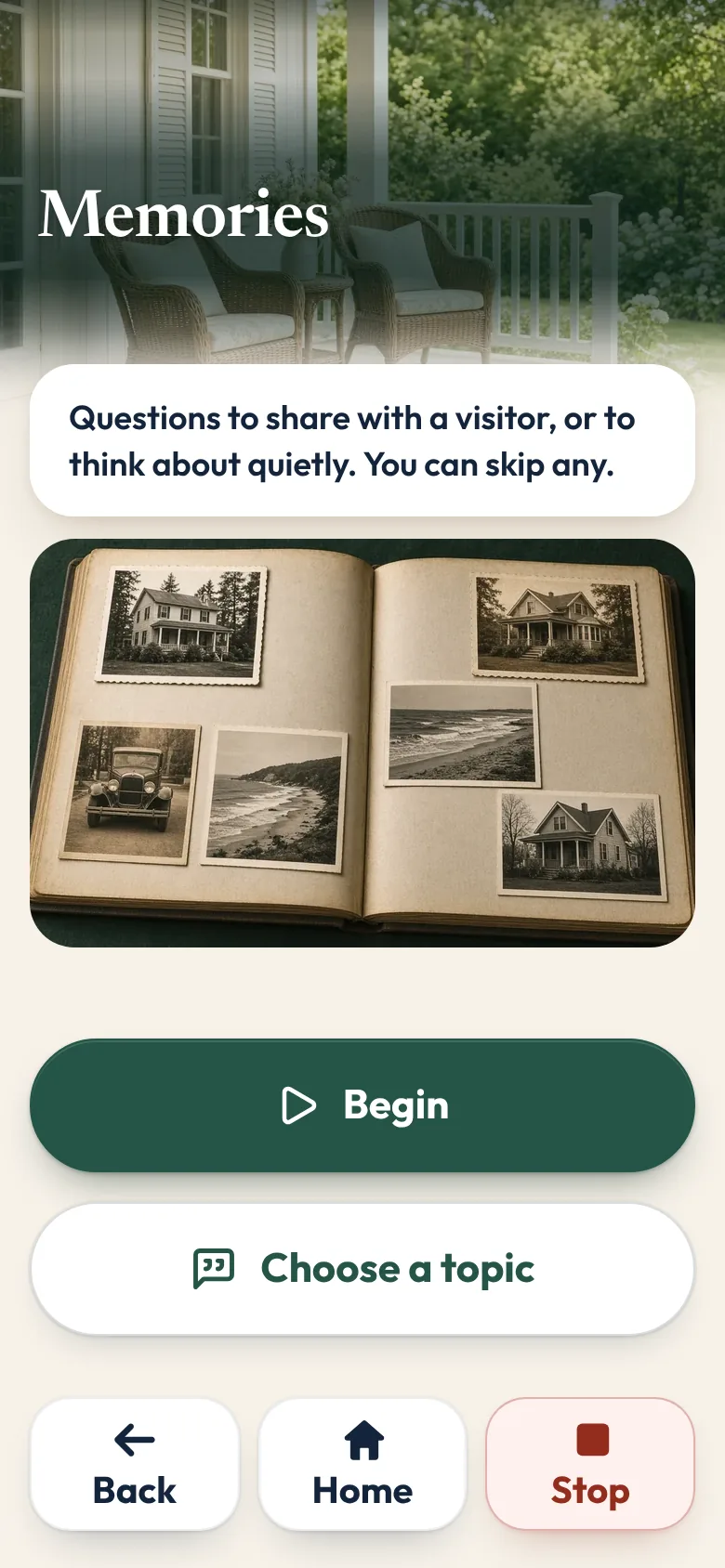
Memories
150 gentle questions in nine topics, from growing up and home to music, food and celebrations. The screen says: “Questions to share with a visitor, or to think about quietly. You can skip any.”
-
Talking about the past
Reminiscence means talking about past times, and it has been studied for decades. Pooling 128 studies, it brought small to moderate gains, including in wellbeing and low mood, and most lasted to follow-up.
A meta-analysis of 128 studies (2012). Source 32
-
Living at home
In an earlier review of 15 studies, reminiscence had a moderate effect on life satisfaction and wellbeing, and a bigger one for older people living at home than for people in care homes.
A meta-analysis of 15 studies (2007). Source 33
-
Living with dementia
For people with dementia, a review of 22 trials with 1,972 people found small and inconsistent effects: probably a slight lift in mood from one-to-one sessions, and possible gains in communication from group sessions.
A Cochrane review of 22 trials (2018). Source 34
-
Asking gently
Dementia Australia advises asking questions that need a yes or no, or that offer a few choices, and avoiding direct questions that rely on a good memory. These questions have no right answers, any of them can be skipped, and some have a softer follow-on question if the first draws a blank.
A Dementia Australia help sheet (2022). Source 35
Keep in mind
The studies tested planned sessions with trained leaders, often in groups, over several weeks. We found no studies of conversation questions on a phone.
When people with dementia and their family carers joined reminiscence groups together, a large trial found no benefit, and the carers felt more anxious (Source 36). Activities that bring generations together have shown only small, uncertain effects so far (Source 37). So nothing here is a test, and there’s no wrong way to use it.
For practical steps on a phone, see A simple phone app for seniors with memory changes.
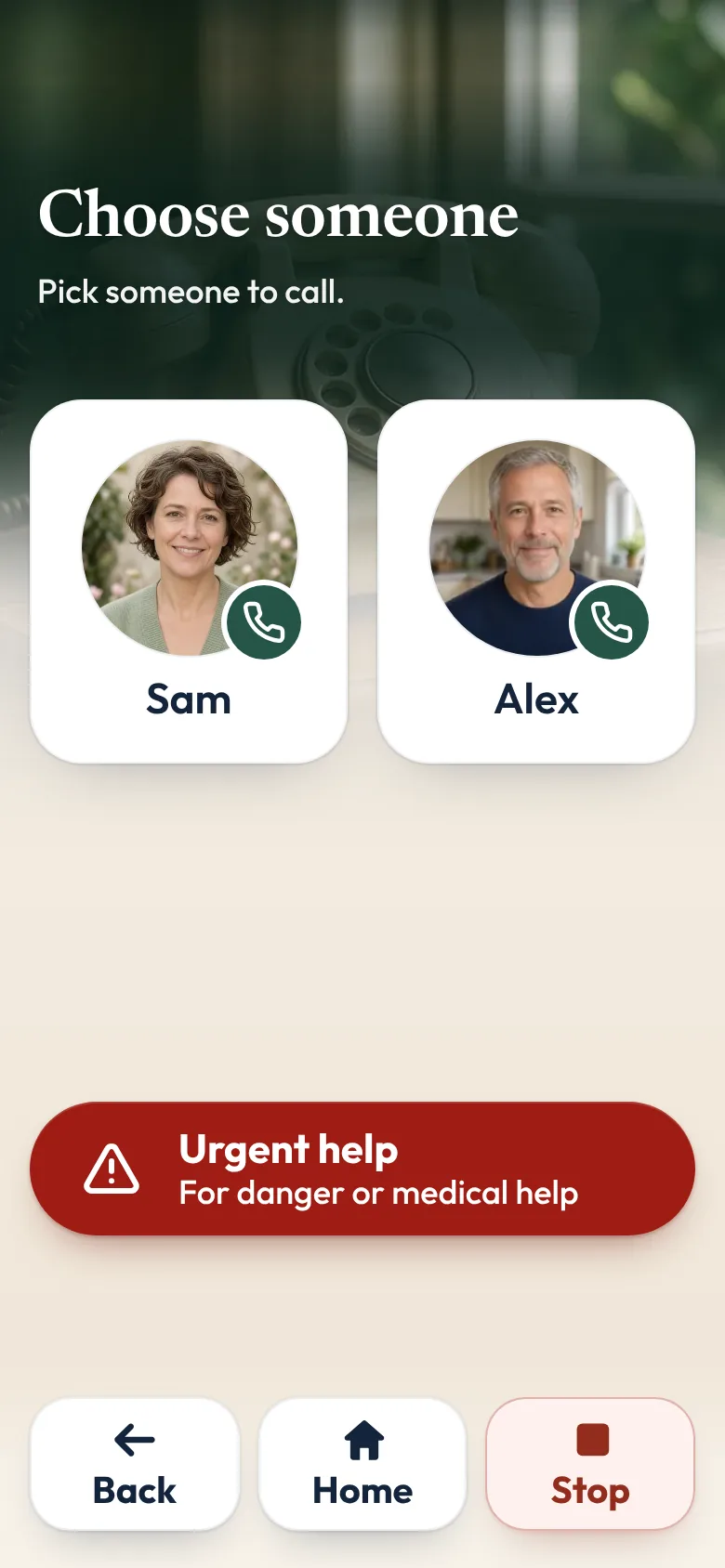
Call
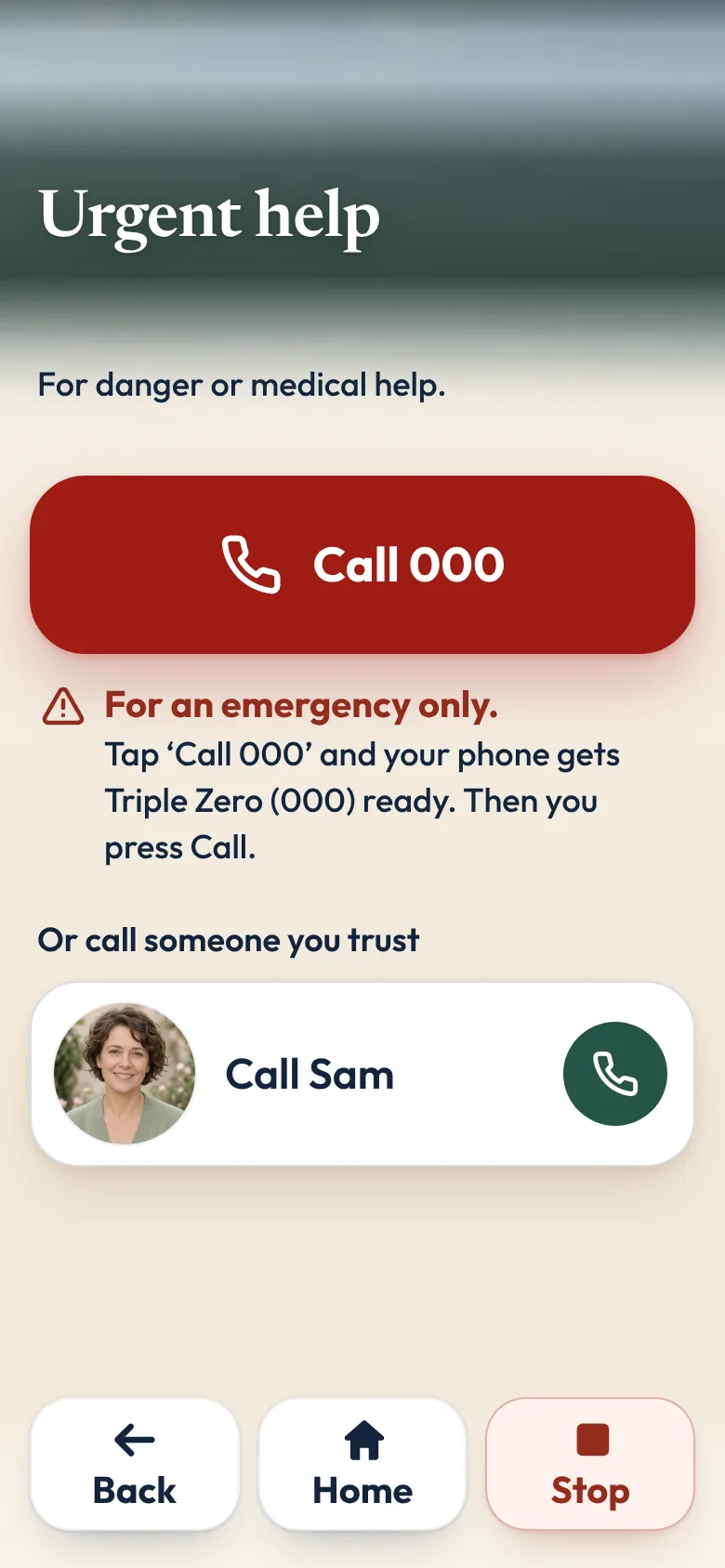
Up to four people they trust, each with a name, and a photo if the family adds one. A tap shows their photo or initial, “Call {name}?” and the number, with a “Call {name}” button. That opens the phone’s own dialler with the number ready, and they press Call themselves.
-
Relationships and a long life
A review of 148 studies with 308,849 people found that people with stronger social relationships had about 50% higher odds of being alive at follow-up, which averaged seven and a half years. The authors compared the size of the effect with quitting smoking. The US Surgeon General later put it this way: a lack of social connection can raise the risk of early death as much as smoking up to 15 cigarettes a day.
A meta-analysis of 148 studies (2010) and a US public health advisory (2023). Sources 38 and 39
-
Loneliness and isolation
A later review of 70 studies with about 3.4 million people linked loneliness, social isolation and living alone with a 26%, 29% and 32% higher likelihood of dying early. The World Health Organization links loneliness to an estimated 871,000 deaths a year.
A meta-analysis of 70 studies (2015) and a WHO report (2025). Sources 40 and 41
-
A friendly phone call
In a four-week trial with 240 mostly older adults, regular friendly phone calls from trained volunteers reduced loneliness, low mood and worry, compared with no calls.
A randomised trial (2021). Source 42
-
Hearing a voice
Most people expected a phone call to feel more awkward than an email. But in one experiment, people who phoned an old friend felt a stronger bond than people who emailed, and the call felt no more awkward.
A series of experiments (2021). Source 43
Keep in mind
The big reviews show links, not proof that connection causes better health. None of these studies tested Sunday Visit, and the phone trial used trained callers, not family.
Sunday Visit simply makes it easier to call the people they trust.
For practical steps when you live far away, see How to stay in touch with elderly parents who live far away.
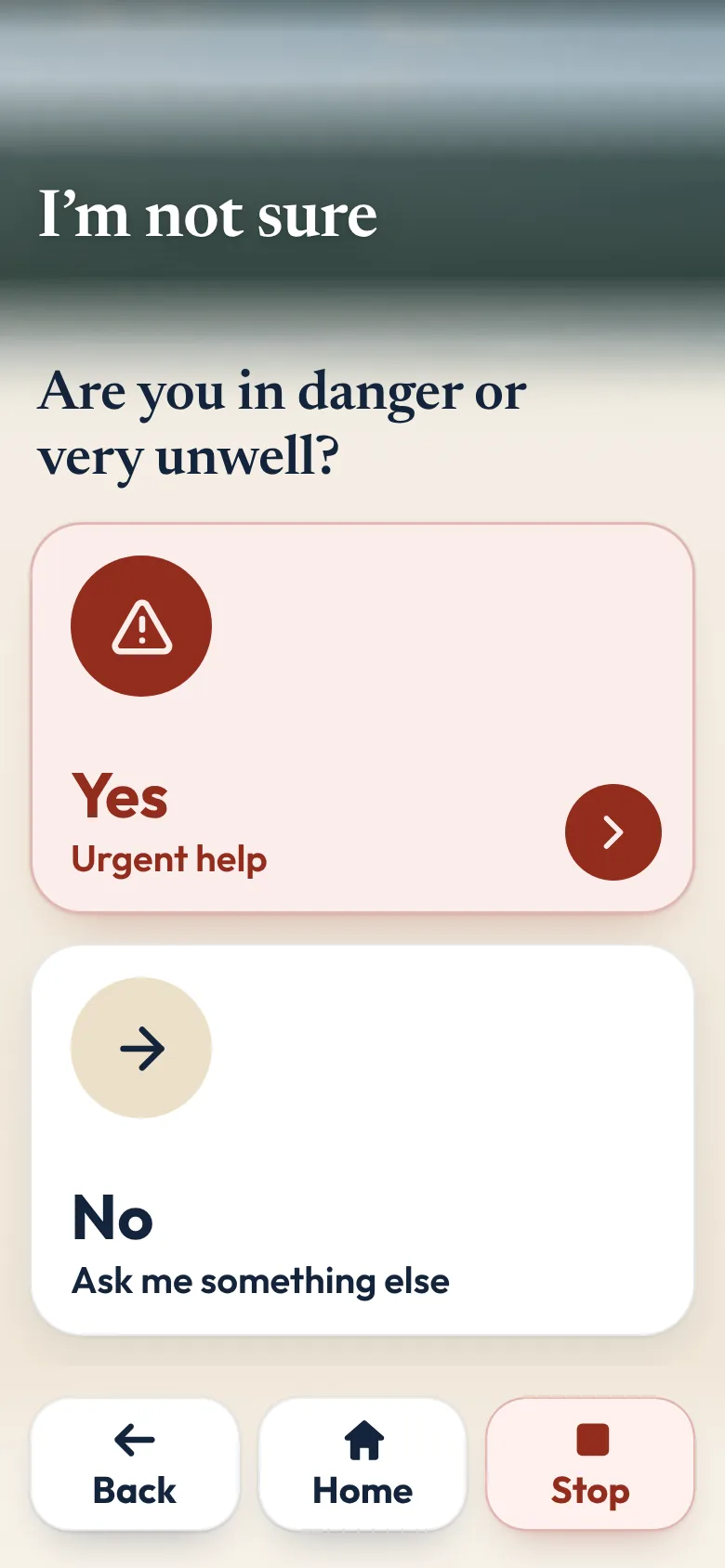
I’m not sure
For the moments they don’t know what they need. Up to five yes-or-no questions, starting with “Are you in danger or very unwell?”, then whether they’d like to feel calmer, talk to someone, see something familiar (when the album has something in it) or play a simple game. A yes opens that part of the app. If every answer is no, it ends on a calm card offering a call to the first person they trust, if someone is saved, and Something familiar (or Memories when the album is empty).
-
Fewer choices
In a survey of 201 people about choices from doctors to jam, adults aged 60 to 94 wanted about half as many options as young adults: around 5, against around 10.
A survey study (2008). Source 44
-
Yes or no
Dementia Australia advises asking questions that need a yes or no, or that offer a few choices. England’s dementia guideline says to use adapted ways of communicating if needed, like visual aids or simplified text.
A Dementia Australia help sheet (2022) and NICE guideline NG97 (2018). Sources 27 and 35
Keep in mind
No study has tested this exact set of questions. It isn’t a medical or safety check, and it never replaces calling Triple Zero (000) or a doctor.
Urgent help
Urgent help asks once more (“Call Triple Zero (000)?”), then opens the phone’s dialler with the emergency number ready, and they press Call. The family can turn the extra question off. In Australia, that’s Triple Zero (000). In New Zealand, the UK, the US, Canada, India and the European Union, it’s that country’s official number. Anywhere else, it says “Call your local emergency number” rather than guess. It can also show the first person they trust. It’s off the Home screen until it’s turned on, and it’s always one tap away from Call.
-
The right number
The Australian Government describes Triple Zero (000) as Australia’s main emergency number for life-threatening or time-critical situations. Every number in Urgent help was checked against an official government source like this one.
An Australian Government page. Source 45
-
They stay in charge
An early W3C draft on supported decision-making says the person stays the decision-maker: a helper supports, but they have the final say. Australia’s new aged care law, which started on 1 November 2025, gives people in funded aged care the right to make their own decisions. Urgent help works the same way: it never calls anyone by itself.
An early W3C draft (2026) and an Australian Government explainer (2025). Sources 46 and 47
Keep in mind
Sunday Visit isn’t an emergency service, and it never calls for them. It doesn’t detect falls, send alerts or share their location. In an emergency, call Triple Zero (000) straight away.
How the screens are built
The same research shaped how every screen looks and works, for shaky hands, tired eyes and a mind that shouldn’t be rushed.
-
Big buttons
The main buttons on their screen are at least 66 pixels tall, about 10.5 millimetres, and the Home buttons are much bigger. Small extras, like the button that closes a panel, are at least 56. Each Home button is about half the width of the screen. The web accessibility standard, WCAG 2.2, asks for at least 24 by 24 pixels, and 44 by 44 at its highest level. Apple recommends 44 by 44 points and Google 48 by 48. A study with older adults points bigger again: with 40 people aged 65 to 95, tapping worked best on targets 14 to 17.5 millimetres across.
WCAG 2.2 (2024), Apple and Google design guidance, and a study of 40 older adults (2012). Sources 48, 49, 50 and 51
-
Shaky hands
Essential tremor, one common cause of shaky hands, affects about 6% of people aged 65 and over, and becomes more common with each decade. On touchscreens, tremor can make a finger slip off a button or tap twice. Most of Sunday Visit’s buttons ignore a second tap that comes within about four tenths of a second of the first. That timing is our own choice, not a number from research.
A meta-analysis of 42 studies (2021) and a touchscreen study (2011). Sources 52 and 53
-
Big, clear words
Focusing up close gets harder with age, and presbyopia affected about 1.8 billion people in 2015. Older eyes also pick up less contrast, so pale grey text gets harder to read. WCAG asks for text contrast of at least 4.5 to 1, or 7 to 1 at its highest level. In all six of Sunday Visit’s colour palettes, the main text has a contrast of more than 13 to 1. Text on their screen is never smaller than 18 pixels. Until a size is chosen in the app, the words follow the phone’s own text size, from Standard up to the app’s biggest.
A global study (2018), a review of ageing and vision (2011) and WCAG 2.2 (2024). Sources 48, 54 and 55
-
Pictures with words
Every Home button has a picture and words together. W3C’s guidance on cognitive accessibility says clear icons act as signposts to the words, and can help older people who find busy screens hard to read. Apple’s guidance for its simplified iPhone mode says buttons should have both an icon and a label.
W3C guidance (2021) and Apple design guidance (2025). Sources 56 and 57
-
Read aloud
With Read words aloud on, the phone’s own voice reads the screen. At least 2.2 billion people have a vision impairment, and trouble seeing up close because of uncorrected presbyopia affected an estimated 826 million people in 2015. The voice reads at its normal speed, with a Slower choice in Settings: in an experiment with younger, middle-aged and older adults, slowing a synthetic voice made its words harder to pick out for every age group.
WHO World report on vision (2019), a global study (2018) and one experiment (2007). Sources 54, 58 and 59
-
Sound you can also see
Every sound in the app comes with something to see. In Follow the lights, each note plays as its picture lights up. In Slow breathing, each note comes with the words “Breathe in” or “Breathe out”. Words read aloud are on the screen too. No step depends on hearing a sound. Among people older than 60, more than a quarter have disabling hearing loss.
WHO fact sheet (2026). Source 60
-
No hurry
The activities have no countdowns and no time limits, and the Home screen says “Take your time”. Many older adults need more time than younger adults to spot and recognise what they see. At its most basic level, WCAG says time limits must be adjustable, and Apple advises avoiding timed interactions so people can go at their own pace.
A review of ageing and vision (2011), WCAG 2.2 (2024) and Apple design guidance (2025). Sources 48, 55 and 57
-
Never marked wrong
There are no scores, and nothing tells them they got it wrong. Across many studies of older adults, reminders of negative stereotypes about ageing made people do worse on tests. The effect was small to medium.
A meta-analysis (2015). Source 61
-
Fewer buttons on each screen
The Home screen has six big buttons and I’m not sure, and most other screens have fewer. Apple’s guidance for its simplified iPhone mode says to keep each screen’s options few and to break tasks into steps, and older adults in one survey wanted about half as many options as young adults.
Apple design guidance (2025) and a survey study (2008). Sources 44 and 57
-
No accounts or passwords
There’s no account, email or password to remember. Since 2023, WCAG has said signing in shouldn’t depend on remembering a password or solving a puzzle unless there’s another way or help, because some people can’t.
WCAG 2.2 (2024). Source 48
-
Privacy
The apps have no ads, never sell your information, and never share their location. In a 2026 national survey, 87% of Australians wanted more control and choice over how their data is collected and used. In the 2023 survey, 91% of people aged 65 and over said privacy should mean their information isn’t shared without their consent.
National surveys of 1,504 Australians (2026) and 1,916 Australians (2023). Sources 62 and 63
For the family
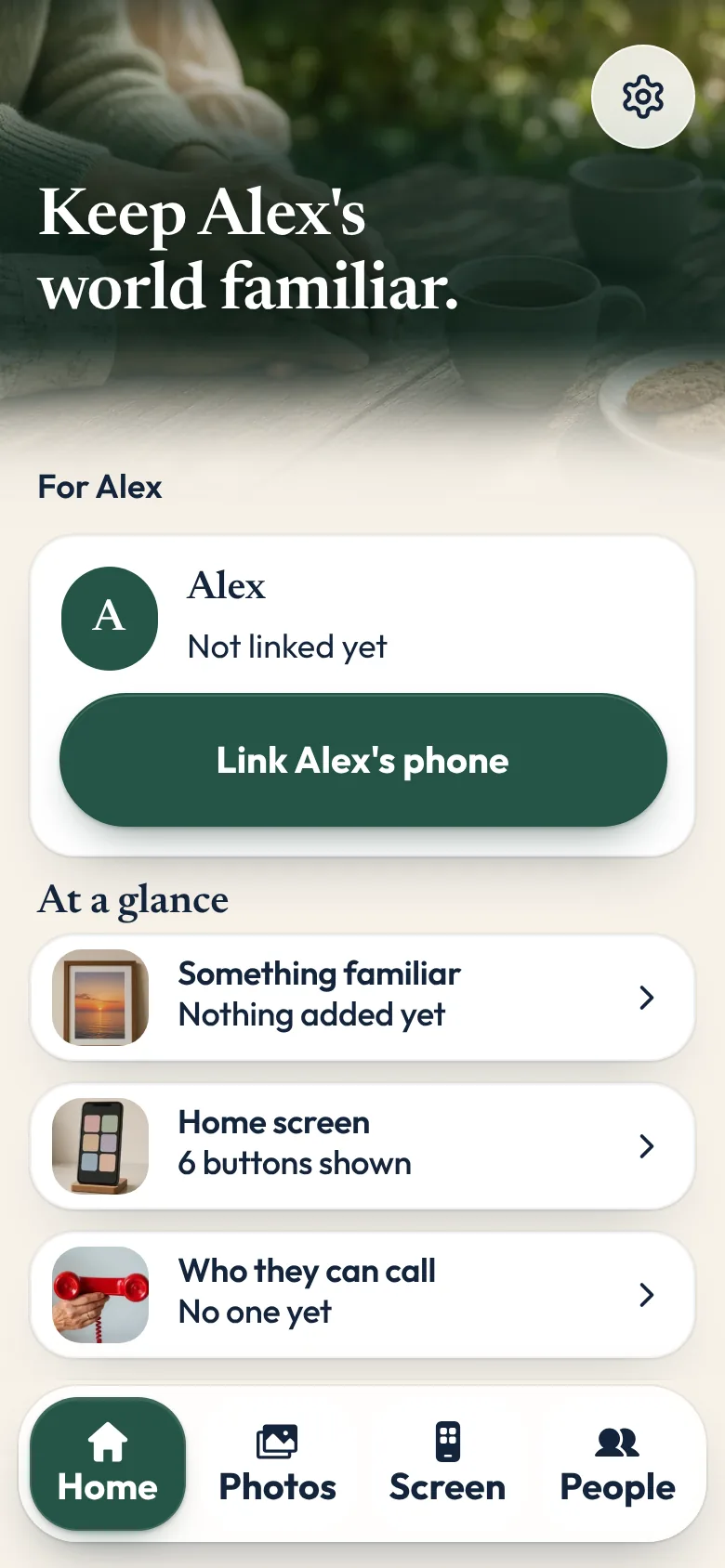
Sunday Visit Carer is the second app, for the family. They link their phone once, with the older person, by an invite link, a QR code or a 6-number code. Then they can choose which buttons show, add the people to call, and send photos, songs and videos. The older person’s phone shows everyone linked to it, and can remove anyone.
-
Family gets people started
In home interviews with older adults in the Netherlands, family often helped them start using new technology and keep using it: children mostly out of concern, grandchildren with an enthusiasm that made it fun.
Interviews with 53 older adults (2015 and 2016). Sources 64 and 65
-
Guiding, not taking over
Older adults new to tablets said unclear instructions, low confidence and health problems got in the way. Several said helpers did things for them instead of showing them how. Sunday Visit is set up together, on their own phone.
A focus-group study with 18 older adults (2017). Source 66
-
Different views of watching
When older women and their adult children were asked about sensors and tracking at home, the children rated the technology more highly than their mothers did. The children underestimated how much their mothers understood, and how much it mattered to involve them in the decision. Privacy was the concern both raised most.
An interview study with 28 people (2020). Source 67
Keep in mind
Sunday Visit Carer never shows what they tap, play or look at. It shows what the family set up, and whether it has arrived on their phone.
Who it’s for, in numbers
Australia’s elderly people, and the families who help them.
-
4.4 million
-
66.5%
of Australians aged 75 and over were digitally excluded in 2025, against about one in five (20.6%) of all Australians.
Australian Digital Inclusion Index (2025). Source 70
-
446,500
-
27.6%
of older Australians living at home lived alone in 2022, and 39.8% needed some help with everyday activities.
ABS (2022 data). Source 68
-
3.0 million
-
871,000
deaths a year around the world are linked to loneliness, by the WHO’s estimate: about 100 every hour. Up to 1 in 3 older adults are socially isolated.
World Health Organization (2025). Source 41
-
1 in 6
people in the world will be aged 60 or over by 2030, and their number is set to reach 2.1 billion by 2050.
World Health Organization (2025). Source 74
Does staying connected matter as we get older?
Yes. Feeling connected to other people is linked with better health and a longer life. Loneliness is common at every age, and many older Australians feel it too.
What the research says
- In 2024, about 15% of Australians were lonely. For people aged 65 and over, the rate fell from 20% in 2001 to 15% in 2024 [75].
- A 2026 national survey of 4,001 people found that 28% of people in Australia are lonely. People aged 65 to 74 were among the most socially isolated, at 27% [76].
- In the same survey, feeling close and connected to family went with a 20% lower risk of being both lonely and socially isolated [76].
- The World Health Organization (WHO) estimates that loneliness is linked to 871,000 deaths a year. Up to 1 in 3 older adults are socially isolated [41].
- A review of 148 studies with 308,849 people found a 50% greater chance of survival for people with stronger social relationships [38].
- Hearing a voice matters. In experiments, phone, video and voice chats built stronger bonds than email or text. They weren’t more awkward, even though people expected them to be [43].
- In a trial with 240 adults, regular friendly phone calls over 4 weeks lowered loneliness compared with a control group [42].
What we don’t know yet
- Technology alone isn’t a proven fix. A Cochrane review found only 3 small trials of video calls, with 201 people. The evidence was “very uncertain” [77].
- A review of 6 studies with 646 people found no clear evidence that digital tools reduced loneliness in older adults [79].
- A larger review covered 70 studies with 8,259 people. Most approaches had a small effect, and the overall quality of the evidence was very low [78].
How this shapes Sunday Visit
Sunday Visit keeps calling simple. Call holds up to 4 people. Family can also add photos, sounds and videos to the album.
Why do familiar faces, photos and songs help?
Familiar things can prompt memories and conversation. Photos and music are some of the most common ways families and care staff do this.
What the research says
- Dementia Australia suggests making a memory book together. It can hold photos, letters and favourite music. It suggests captioning photos and keeping each page simple, with one topic and two to three images. A tablet version works too [83].
- A review of life story books found they helped trigger memories and improve relationships with the person living with dementia [13].
- A 2026 review of digital reminiscence in care homes found benefits for mood, communication and social interaction. Findings were mixed, and the studies were small [14].
- Memory for music can stay strong even in advanced Alzheimer’s disease. A brain study may help explain why [15].
- A Cochrane review of music-based approaches for people with dementia included 30 trials with 1,720 people [16].
- A review of 15 trials with 1,144 older adults found the largest effects on depression from music sessions of more than 60 minutes a week, especially with a music therapist [18].
How this shapes Sunday Visit
Album holds up to 200 photos, sounds and videos in three lists, newest first. Family add them from the Carer app, and the phone itself can take photos and record sounds and videos, so the lists fill with faces and songs your loved one knows.
What is reminiscence, and does it help?
Reminiscence means talking about memories from the past. For many older people it’s a warm, everyday way to connect. Studies suggest it can support mood and life satisfaction.
What the research says
- A review of 31 studies with 1,829 older adults without memory problems found fewer depressive symptoms and higher life satisfaction after reminiscence [81].
- A 2025 review of 22 studies found reminiscence was linked with less loneliness in older adults [80].
- An earlier review of 128 studies found moderate improvements in depressive symptoms, and smaller gains in purpose in life and wellbeing [32]. Another found larger benefits for people living in the community than in nursing homes [33].
- For people with dementia, a Cochrane review of 22 studies with 1,972 people found little effect on quality of life overall, with a slight benefit in care homes [34].
- Memories can be sad as well as happy. Dementia Australia suggests watching for distress and moving to another activity if needed [83].
- Dementia Support Australia advises pacing sessions to the person’s mood and energy, and not correcting what they remember [84].
How this shapes Sunday Visit
Memories has 150 questions across 9 topics, such as childhood and food. There is no right answer, and no score.
What kind of gentle activity is recommended?
Moving a little, often, is good for older people. Australian guidelines suggest light activity every day, plus some strength and balance work each week.
What the research says
- Australia’s guidelines for people aged 65 and over include several hours of light activity each day. They suggest balance and coordination activities on 3 or more days a week. They also suggest breaking up long periods of sitting as often as possible [85].
- A review of 25 studies with 1,388 people found chair-based exercise improved arm and leg strength in older adults [21].
- A Cochrane review found that exercise programmes reduce falls in older people living in the community. Balance and functional exercises were the main type [25].
- Mindfulness helps older adults, but modestly [24]. A body scan on its own showed only a small effect [23].
Slow breathing and calm activities
- A review of 223 studies found slow breathing raises heart rate variability, a sign the body is settling [1].
- A review of 12 trials with 785 people found breathwork went with lower stress. The authors urged caution [2].
- In one small study, a single session of deep, slow breathing reduced anxiety in both younger and older adults [4].
- A review of natural sounds, such as birdsong, wind and water, found links with health benefits [8].
How this shapes Sunday Visit
Move offers chair and lying-down options and shows one safety line: “Only if comfortable. Stop if sore or dizzy.” Slow breathing is 8 breaths, at a Gentle pace (in 4, out 6) or a Slower pace (in 5, out 7).
What makes a screen easier to use as we age?
Large buttons, clear text, strong contrast and plain words help everyone. They matter most for people with changes in vision, hearing, memory or hand control.
What the research says
- At least 2.2 billion people worldwide have a near or distance vision impairment. Most people with vision loss are over 50 [91].
- In a study of 1,260 healthy older Australians, 49.7% had age-related hearing loss on a hearing test [82].
- Essential tremor, a common cause of shaky hands, affects about 6% of people aged 65 and over (pooled prevalence 5.79%) [52].
- WCAG 2.2, the international web accessibility standard, sets a minimum tap target of 24 by 24 pixels. It explains that small targets are hard for people with hand tremors [89]. Apple suggests at least 44 by 44 points [49]. Google suggests at least 48dp [50].
- WCAG asks for text contrast of at least 4.5:1, and 7:1 at the higher level [48].
- The W3C says sites that are accessible to people with disability are also more accessible to older users [88].
- In 2025, 66.5% of Australians aged 75 and over were digitally excluded, compared with 20.6% of all Australians [70].
- Older adults wanted fewer choices than younger adults in all 6 areas tested [44].
- The Australian Government Style Manual says to use everyday words and plain language [90]. Dementia Australia suggests short, simple sentences with one idea at a time, and yes or no questions [35].
How this shapes Sunday Visit
Main buttons are 66px or more. Text is 18px or more. Read words aloud can read each screen. Activities have no clock and no score, and the app says “Take your time.”
How can families share the care?
Millions of Australians care for someone. Caring can be rewarding and demanding. Sharing the load, and asking for support early, helps.
What the research says
- In 2022, 3.0 million Australians were carers, and 1.2 million were primary carers [68].
- That is 12% of the population. More than 1 in 3 carers (38%) were primary carers, and 68% of primary carers were female [86].
- In the 2024 National Carer Survey of 10,096 carers, most cared for 40 or more hours a week. 54% reported high to very high distress, up from 48% in 2020 [86].
- In 2022, only 49% of primary carers said they had no unmet need for respite care [86].
- Care from family and friends was valued at $77.9 billion in 2020 [73].
- Family shapes how older people take up technology. Grandchildren often bring enthusiasm, which can lighten the load on adult children [64].
- Older adults and their children can see technology differently. In one study, privacy was the top concern for both [67]. In Australia, 91% of people aged 65 and over said privacy means their information isn’t shared without consent [63].
Support for carers
- Carer Gateway is an Australian Government program with services and support for carers, including counselling and respite. Call 1800 422 737, Monday to Friday, 8am to 5pm [87].
- The National Dementia Helpline is there for anyone with questions about dementia. Call 1800 100 500 [83].
How this shapes Sunday Visit
Family can join from the Carer app with a 6-number code. The code works once, for 10 minutes. Your loved one chooses up to 4 people to call.
Questions people ask
Can technology help with loneliness in older people?
It can help people stay in touch, but it isn’t a proven fix on its own. Reviews of video calls and digital tools found the evidence uncertain or weak [77, 78, 79]. Hearing a familiar voice seems to matter. Calls built stronger bonds than text messages [43], and a trial of regular friendly phone calls lowered loneliness [42].
How common is loneliness among older Australians?
In 2024, about 15% of Australians aged 65 and over were lonely, down from 20% in 2001 [75]. A 2026 survey found 27% of people aged 65 to 74 were socially isolated [76].
Why use family photos and music?
Familiar photos and songs can prompt memories and conversation. Dementia Australia suggests a memory book with photos, captions and favourite music [83]. Memory for music can last even in advanced Alzheimer’s disease [15].
Is talking about the past good for people without dementia?
Studies suggest it can be. A review of 31 studies found fewer depressive symptoms and higher life satisfaction in older adults without memory problems [81].
How much should older people move?
Australia’s guidelines for people 65 and over suggest several hours of light activity a day, plus balance activities on 3 or more days a week [85].
Does slow breathing really help?
Reviews link slow breathing and breathwork with lower stress, though the authors urge caution [1, 2]. It isn’t a treatment. For health worries, please see a doctor or pharmacist.
Why are the buttons so big?
Bigger buttons are easier to tap, especially with a tremor or changes in vision. Standards set 24 pixels as the minimum [89]. Sunday Visit’s main buttons are 66px or more.
Where can carers get support?
Carer Gateway offers support, including counselling and respite, on 1800 422 737 [87]. The National Dementia Helpline is 1800 100 500 [83].
Is Sunday Visit a medical device?
No. Sunday Visit is a wellbeing app, not a medical device or emergency service. In an emergency, call Triple Zero (000). Triple Zero (000) is Australia’s main emergency number for life-threatening or time-critical situations [45].
How we chose the research
We looked for the strongest evidence first, and we say plainly where it’s thin.
-
Reviews first
Where we could, we used systematic reviews, which pool many studies, and guidelines from bodies like the World Health Organization and NICE in the UK.
-
Checked against the source
Every finding here was checked against the paper, guideline or report itself, not a news story about it.
-
The limits stay in
Each part ends with what the research doesn’t show. Most studies were small or short, or tested something different from our app.
-
Kept up to date
We look for newer reviews and figures, and update this page when they change what it says. Spotted something wrong? Email hello@sundayvisit.com.au.
Every source
Sources 1 to 74 are numbered in the order this page first uses them. Sources 75 to 91 were added on 1 November 2026 and are listed after the originals. Each title links to the paper, guideline or report.
- 1Laborde S, Allen MS, Borges U, and others (2022). Effects of voluntary slow breathing on heart rate and heart rate variability: a systematic review and a meta-analysis. Neuroscience & Biobehavioral Reviews, 138, 104711. Used in Calm.
- 2Fincham GW, Strauss C, Montero-Marin J, Cavanagh K (2023). Effect of breathwork on stress and mental health: a meta-analysis of randomised-controlled trials. Scientific Reports, 13, 432. Used in Calm.
- 3Van Diest I, Verstappen K, Aubert AE, and others (2014). Inhalation/exhalation ratio modulates the effect of slow breathing on heart rate variability and relaxation. Applied Psychophysiology and Biofeedback, 39(3–4), 171–180. Used in Calm.
- 4Magnon V, Dutheil F, Vallet GT (2021). Benefits from one session of deep and slow breathing on vagal tone and anxiety in young and older adults. Scientific Reports, 11, 19267. Used in Calm.
- 5Galante J, Friedrich C, Dawson AF, and others (2021). Mindfulness-based programmes for mental health promotion in adults in nonclinical settings: a systematic review and meta-analysis of randomised controlled trials. PLOS Medicine, 18(1), e1003481. Used in Calm.
- 6Davis DE, Choe E, Meyers J, and others (2016). Thankful for the little things: a meta-analysis of gratitude interventions. Journal of Counseling Psychology, 63(1), 20–31. Used in Calm.
- 7Killen A, Macaskill A (2015). Using a gratitude intervention to enhance well-being in older adults. Journal of Happiness Studies, 16(4), 947–964. Used in Calm.
- 8Buxton RT, Pearson AL, Allou C, and others (2021). A synthesis of health benefits of natural sounds and their distribution in national parks. Proceedings of the National Academy of Sciences, 118(14), e2013097118. Used in Calm.
- 9Lynn CD (2014). Hearth and campfire influences on arterial blood pressure: defraying the costs of the social brain through fireside relaxation. Evolutionary Psychology, 12(5), 983–1003. Used in Calm.
- 10Ulrich RS (1984). View through a window may influence recovery from surgery. Science, 224(4647), 420–421. Used in Calm.
- 11Browning MHEM, Shipley N, McAnirlin O, and others (2020). An actual natural setting improves mood better than its virtual counterpart: a meta-analysis of experimental data. Frontiers in Psychology, 11, 2200. Used in Calm.
- 12Zaccaro A, Piarulli A, Laurino M, and others (2018). How breath-control can change your life: a systematic review on psycho-physiological correlates of slow breathing. Frontiers in Human Neuroscience, 12, 353. Used in Calm.
- 13Elfrink TR, Zuidema SU, Kunz M, Westerhof GJ (2018). Life story books for people with dementia: a systematic review. International Psychogeriatrics, 30(12), 1797–1811. Used in Album.
- 14Heward M, Szymanska A, Farrington S, and others (2026). Digital reminiscence-based interventions to enhance social interaction of people with dementia in care homes: a scoping review. Dementia, published online. Used in Album.
- 15Jacobsen J-H, Stelzer J, Fritz TH, and others (2015). Why musical memory can be preserved in advanced Alzheimer’s disease. Brain, 138(8), 2438–2450. Used in Album.
- 16van der Steen JT, van der Wouden JC, Methley AM, and others (2025). Music-based therapeutic interventions for people with dementia. Cochrane Database of Systematic Reviews, issue 3, CD003477. Used in Album.
- 17Sisti A, Gutman R, Mor V, and others (2024). Using structured observations to evaluate the effects of a personalized music intervention on agitated behaviors and mood in nursing home residents with dementia: results from an embedded, pragmatic randomized controlled trial. American Journal of Geriatric Psychiatry, 32(3), 300–311. Used in Album.
- 18Dhippayom T, Saensook T, Promkhatja N, and others (2022). Comparative effects of music interventions on depression in older adults: a systematic review and network meta-analysis. eClinicalMedicine, 50, 101509. Used in Album.
- 19Abraha I, Rimland JM, Lozano-Montoya I, and others (2020). Simulated presence therapy for dementia. Cochrane Database of Systematic Reviews, issue 4, CD011882. Used in Album.
- 20World Health Organization (2020). WHO guidelines on physical activity and sedentary behaviour. Geneva: WHO. Used in Move.
- 21Klempel N, Blackburn NE, McMullan IL, and others (2021). The effect of chair-based exercise on physical function in older adults: a systematic review and meta-analysis. International Journal of Environmental Research and Public Health, 18(4), 1902. Used in Move.
- 22Crocker T, Forster A, Young J, and others (2013). Physical rehabilitation for older people in long-term care. Cochrane Database of Systematic Reviews, issue 2, CD004294. Used in Move.
- 23Gan R, Zhang L, Chen S (2022). The effects of body scan meditation: a systematic review and meta-analysis. Applied Psychology: Health and Well-Being, 14(3), 1062–1080. Used in Move.
- 24Verhaeghen P, Aikman SN, Mirabito G, and others (2025). Mindfulness interventions in older adults for mental health and well-being: a meta-analysis. The Journals of Gerontology: Series B, 80(4), gbae205. Used in Move.
- 25Sherrington C, Fairhall NJ, Wallbank GK, and others (2019). Exercise for preventing falls in older people living in the community. Cochrane Database of Systematic Reviews, issue 1, CD012424. Used in Move.
- 26Montero-Odasso M, van der Velde N, Martin FC, and others (2022). World guidelines for falls prevention and management for older adults: a global initiative. Age and Ageing, 51(9), afac205. Used in Move.
- 27National Institute for Health and Care Excellence (NICE) (2018). Dementia: assessment, management and support for people living with dementia and their carers (guideline NG97). London: NICE. Last changed in June 2025, and checked again by NICE in October 2025 with no update; the recommendations cited here are unchanged. Used in Games, I’m not sure.
- 28Woods B, Rai HK, Elliott E, and others (2023). Cognitive stimulation to improve cognitive functioning in people with dementia. Cochrane Database of Systematic Reviews, issue 1, CD005562. Used in Games.
- 29Gates NJ, Rutjes AWS, Di Nisio M, and others (2020). Computerised cognitive training for 12 or more weeks for maintaining cognitive function in cognitively healthy people in late life. Cochrane Database of Systematic Reviews, issue 2, CD012277. Used in Games.
- 30Bridges KA, Van Lancker Sidtis D (2013). Formulaic language in Alzheimer’s disease. Aphasiology, 27(7), 799–810. Used in Games.
- 31Rapp AM, Wild B (2011). Nonliteral language in Alzheimer dementia: a review. Journal of the International Neuropsychological Society, 17(2), 207–218. Used in Games.
- 32Pinquart M, Forstmeier S (2012). Effects of reminiscence interventions on psychosocial outcomes: a meta-analysis. Aging & Mental Health, 16(5), 541–558. Used in Memories.
- 33Bohlmeijer E, Roemer M, Cuijpers P, Smit F (2007). The effects of reminiscence on psychological well-being in older adults: a meta-analysis. Aging & Mental Health, 11(3), 291–300. Used in Memories.
- 34Woods B, O’Philbin L, Farrell EM, and others (2018). Reminiscence therapy for dementia. Cochrane Database of Systematic Reviews, issue 3, CD001120. Used in Memories.
- 35Dementia Australia (2022). Communication (help sheet 1 in the series Caring for someone with dementia). Reviewed October 2022. Used in Memories, I’m not sure.
- 36Woods RT, Bruce E, Edwards RT, and others (2012). REMCARE: reminiscence groups for people with dementia and their family caregivers – effectiveness and cost-effectiveness pragmatic multicentre randomised trial. Health Technology Assessment, 16(48). Used in Memories.
- 37Whear R, Campbell F, Rogers M, and others (2023). What is the effect of intergenerational activities on the wellbeing and mental health of older people? A systematic review. Campbell Systematic Reviews, 19(4), e1355. Used in Memories.
- 38Holt-Lunstad J, Smith TB, Layton JB (2010). Social relationships and mortality risk: a meta-analytic review. PLOS Medicine, 7(7), e1000316. Used in Call.
- 39Office of the US Surgeon General (2023). Our epidemic of loneliness and isolation: the US Surgeon General’s advisory on the healing effects of social connection and community. Washington, DC: US Department of Health and Human Services. Used in Call.
- 40Holt-Lunstad J, Smith TB, Baker M, and others (2015). Loneliness and social isolation as risk factors for mortality: a meta-analytic review. Perspectives on Psychological Science, 10(2), 227–237. Used in Call.
- 41World Health Organization (2025). Social connection linked to improved health and reduced risk of early death. News release on the WHO Commission on Social Connection’s report, 30 June 2025. Used in Call, Who it’s for, in numbers.
- 42Kahlon MK, Aksan N, Aubrey R, and others (2021). Effect of layperson-delivered, empathy-focused program of telephone calls on loneliness, depression, and anxiety among adults during the COVID-19 pandemic: a randomized clinical trial. JAMA Psychiatry, 78(6), 616–622. Used in Call.
- 43Kumar A, Epley N (2021). It’s surprisingly nice to hear you: misunderstanding the impact of communication media can lead to suboptimal choices of how to connect with others. Journal of Experimental Psychology: General, 150(3), 595–607. Used in Call.
- 44Reed AE, Mikels JA, Simon KI (2008). Older adults prefer less choice than young adults. Psychology and Aging, 23(3), 671–675. Used in I’m not sure, How the screens are built.
- 45Australian Government (no date). Triple Zero (000). Department of Infrastructure, Transport, Regional Development, Communications, Sport and the Arts. Used in Urgent help.
- 46World Wide Web Consortium (W3C) (2026). Cognitive accessibility research modules: supported decision-making online. W3C Group Note Draft (an early draft, not a W3C standard), 5 February 2026. Used in Urgent help.
- 47Australian Government Department of Health, Disability and Ageing (2025). Aged Care Act 2024: Statement of Rights explainer. Canberra. Used in Urgent help.
- 48World Wide Web Consortium (W3C) (2024). Web Content Accessibility Guidelines (WCAG) 2.2. W3C Recommendation, 12 December 2024. Used in How the screens are built.
- 49Apple (2025). Human Interface Guidelines: Buttons. Apple Developer. Used in How the screens are built.
- 50Google (no date). Touch target size. Android Accessibility Help. Used in How the screens are built.
- 51Leitão R, Silva PA (2012). Target and spacing sizes for smartphone user interfaces for older adults: design patterns based on an evaluation with users. 19th Conference on Pattern Languages of Programs (PLoP 2012), Tucson, Arizona. Used in How the screens are built.
- 52Louis ED, McCreary M (2021). How common is essential tremor? Update on the worldwide prevalence of essential tremor. Tremor and Other Hyperkinetic Movements, 11(1), 28. Used in How the screens are built.
- 53Wacharamanotham C, Hurtmanns J, Mertens A, and others (2011). Evaluating swabbing: a touchscreen input method for elderly users with tremor. Proceedings of the SIGCHI Conference on Human Factors in Computing Systems (CHI 2011), 623–626. Used in How the screens are built.
- 54Fricke TR, Tahhan N, Resnikoff S, and others (2018). Global prevalence of presbyopia and vision impairment from uncorrected presbyopia: systematic review, meta-analysis, and modelling. Ophthalmology, 125(10), 1492–1499. Used in How the screens are built.
- 55Owsley C (2011). Aging and vision. Vision Research, 51(13), 1610–1622. Used in How the screens are built.
- 56W3C Web Accessibility Initiative (2021). Cognitive accessibility guidance: use icons that help the user. Supplemental guidance to WCAG 2. Used in How the screens are built.
- 57Apple (2025). Customize your app for Assistive Access. WWDC25, session 238. Used in How the screens are built.
- 58World Health Organization (2019). WHO launches first World report on vision. News release, 8 October 2019. Used in How the screens are built.
- 59Roring RW, Hines FG, Charness N (2007). Age differences in identifying words in synthetic speech. Human Factors, 49(1), 25–31. Used in How the screens are built.
- 60World Health Organization (2026). Deafness and hearing loss. Fact sheet, 3 March 2026. Used in How the screens are built.
- 61Lamont RA, Swift HJ, Abrams D (2015). A review and meta-analysis of age-based stereotype threat: negative stereotypes, not facts, do the damage. Psychology and Aging, 30(1), 180–193. A correction has since been published. Used in How the screens are built.
- 62Office of the Australian Information Commissioner (OAIC) (2026). Australian Community Attitudes to Privacy Survey 2026. Canberra: OAIC. Published 28 May 2026. Used in How the screens are built.
- 63Office of the Australian Information Commissioner (OAIC) (2023). Australian Community Attitudes to Privacy Survey 2023. Canberra: OAIC. Used in How the screens are built.
- 64Luijkx K, Peek S, Wouters E (2015). “Grandma, you should do it—it’s cool”: older adults and the role of family members in their acceptance of technology. International Journal of Environmental Research and Public Health, 12(12), 15470–15485. Used in For the family.
- 65Peek STM, Luijkx KG, Rijnaard MD, and others (2016). Older adults’ reasons for using technology while aging in place. Gerontology, 62(2), 226–237. Used in For the family.
- 66Vaportzis E, Giatsi Clausen M, Gow AJ (2017). Older adults perceptions of technology and barriers to interacting with tablet computers: a focus group study. Frontiers in Psychology, 8, 1687. Used in For the family.
- 67Berridge C, Wetle TF (2020). Why older adults and their children disagree about in-home surveillance technology, sensors, and tracking. The Gerontologist, 60(5), 926–934. Used in For the family.
- 68Australian Bureau of Statistics (2024). Disability, Ageing and Carers, Australia: Summary of Findings, 2022. Released 4 July 2024. Used in Who it’s for, in numbers.
- 69Australian Government Treasury (2023). 2023 Intergenerational Report: Australia’s future to 2063. Canberra: Commonwealth of Australia. Used in Who it’s for, in numbers.
- 70Australian Digital Inclusion Index (2025). The 2025 findings. ARC Centre of Excellence for Automated Decision-Making and Society, RMIT University, Swinburne University of Technology and Telstra. Used in Who it’s for, in numbers.
- 71Dementia Australia (2026). Dementia facts and figures. Updated 23 June 2026, using estimates from the Australian Institute of Health and Welfare. Used in Who it’s for, in numbers.
- 72Australian Bureau of Statistics (2025). Causes of Death, Australia, 2024. Released 14 November 2025, with revised data published 7 May 2026. Used in Who it’s for, in numbers.
- 73Deloitte Access Economics (2020). The value of informal care in 2020. Report for Carers Australia, May 2020. Used in Who it’s for, in numbers.
- 74World Health Organization (2025). Ageing and health. Fact sheet, 1 October 2025. Used in Who it’s for, in numbers.
- 75Australian Institute of Health and Welfare. Social isolation and loneliness. Last updated 12 May 2026. Used in Does staying connected matter as we get older?, Questions people ask.
- 76Ending Loneliness Together. State of the Nation 2026: Understanding and rebuilding social connection in Australia. 2026. Used in Does staying connected matter as we get older?, Questions people ask.
- 77Noone C, McSharry J, Smalle M, et al. Video calls for reducing social isolation and loneliness in older people: a rapid review. Cochrane Database of Systematic Reviews, 22 May 2020. Used in Does staying connected matter as we get older?, Questions people ask.
- 78Hoang P, King JA, Moore S, et al. Interventions associated with reduced loneliness and social isolation in older adults: a systematic review and meta-analysis. JAMA Network Open, 17 October 2022. Used in Does staying connected matter as we get older?, Questions people ask.
- 79Shah SGS, Nogueras D, van Woerden HC, et al. Evaluation of the effectiveness of digital technology interventions to reduce loneliness in older adults: systematic review and meta-analysis. Journal of Medical Internet Research, 4 June 2021. Used in Does staying connected matter as we get older?, Questions people ask.
- 80Yang, Zhong, Han, et al. Effects of reminiscence therapy for loneliness in older adults: a systematic review and meta-analysis. Age and Ageing, May 2025. Used in What is reminiscence, and does it help?.
- 81Tam W, Poon SN, Mahendran R, et al. The effectiveness of reminiscence-based intervention on improving psychological well-being in cognitively intact older adults: a systematic review and meta-analysis. International Journal of Nursing Studies, February 2021. Used in What is reminiscence, and does it help?, Questions people ask.
- 82Britt C, Storey E, Woods RL, et al. Age-related hearing loss: a cross-sectional study of healthy older Australians. Gerontology, 21 November 2024. Used in What makes a screen easier to use as we age?.
- 83Dementia Australia. Caring for someone with dementia: Therapies and communication approaches (help sheet). Used in Why do familiar faces, photos and songs help?, What is reminiscence, and does it help?, How can families share the care?, Questions people ask.
- 84Dementia Support Australia. Reminiscence and life story work (help sheet). Used in What is reminiscence, and does it help?.
- 85Australian Government, Department of Health, Disability and Ageing. Recommendations for older adults (65 years and over), 24-hour movement guidelines. Last updated 16 March 2026. Used in What kind of gentle activity is recommended?, Questions people ask.
- 86Australian Institute of Health and Welfare. Informal carers (Australia’s welfare). Last updated 30 October 2025. Used in How can families share the care?.
- 87Carer Gateway, Australian Government. Home page. Used in How can families share the care?, Questions people ask.
- 88W3C Web Accessibility Initiative. Older users and web accessibility. Used in What makes a screen easier to use as we age?.
- 89W3C. Understanding Success Criterion 2.5.8: Target Size (Minimum), WCAG 2.2. Used in What makes a screen easier to use as we age?, Questions people ask.
- 90Australian Government Style Manual. Plain language and word choice. Updated 20 December 2024. Used in What makes a screen easier to use as we age?.
- 91World Health Organization. Blindness and vision impairment (fact sheet), 10 February 2026. Used in What makes a screen easier to use as we age?.
Gentle updates from Sunday Visit
An email now and then, with tips for calm visits and news about the apps. No spam, unsubscribe anytime. Read our privacy note.